


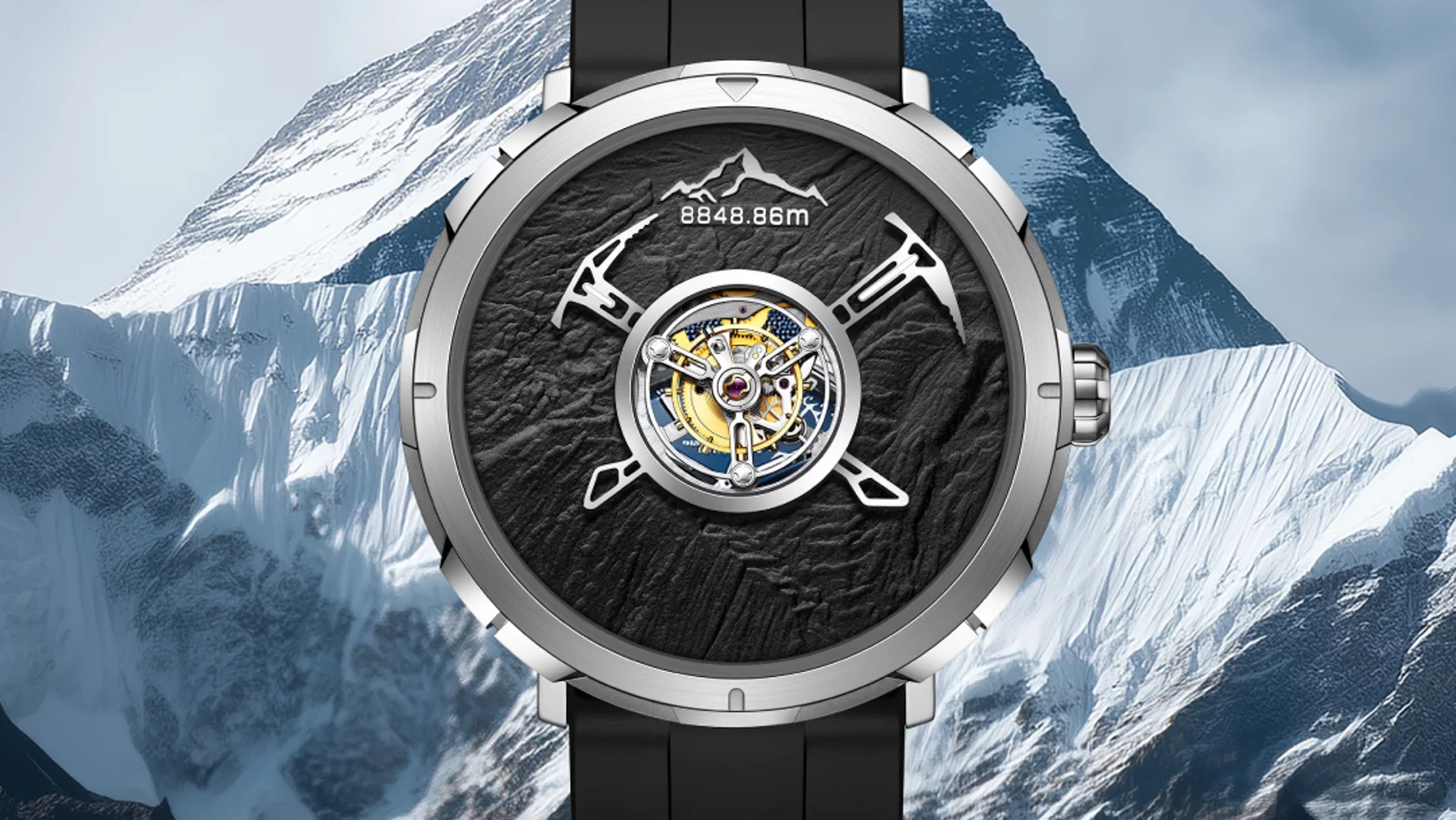
CIGA design’s Everest Summit frames a central tourbillon with real Everest bedrock
Jason Lee- CIGA design celebrates the world’s tallest mountain with an impressive central tourbillon piece.
- It’s an evolution of 2024’s Central Tourbillon Mount Everest Homage Edition, offering the same basic layout and concept yet with a more refined design.
- The central tourbillon is framed by a dial made of real Everest bedrock.
Shenzhen‑based CIGA design—founded by industrial designer Zhang Jianmin—approaches watchmaking as industrial design with mechanics in service of a clear idea. The brand’s Bauhaus‑leaning ethos has earned broad attention, most notably when its Blue Planet won the GPHG Challenge Watch Prize in 2021, the first time a Chinese watch brand received the award. That moment didn’t just validate a single concept; it signalled a broader confidence in a design‑first approach that puts narrative and function ahead of inherited tropes. In the years since, CIGA design has steadily expanded beyond accessible, entry‑level pieces into watches that use materials and display architecture to tell a story.

The Everest Summit Central Tourbillon is the latest example of that trajectory, taking a theme that could have tipped into kitsch and rendering it with a relatively restrained industrial vocabulary. It’s actually an evolution of a watch we covered last year, the Central Tourbillon Mount Everest Homage Edition: while the same basic layout and concept have remained the same with the Everest Summit Central Tourbillon, it’s a more refined design with a redesigned case (which notably has standard lugs rather than the initial model’s lugless design) and a cleaner dial.
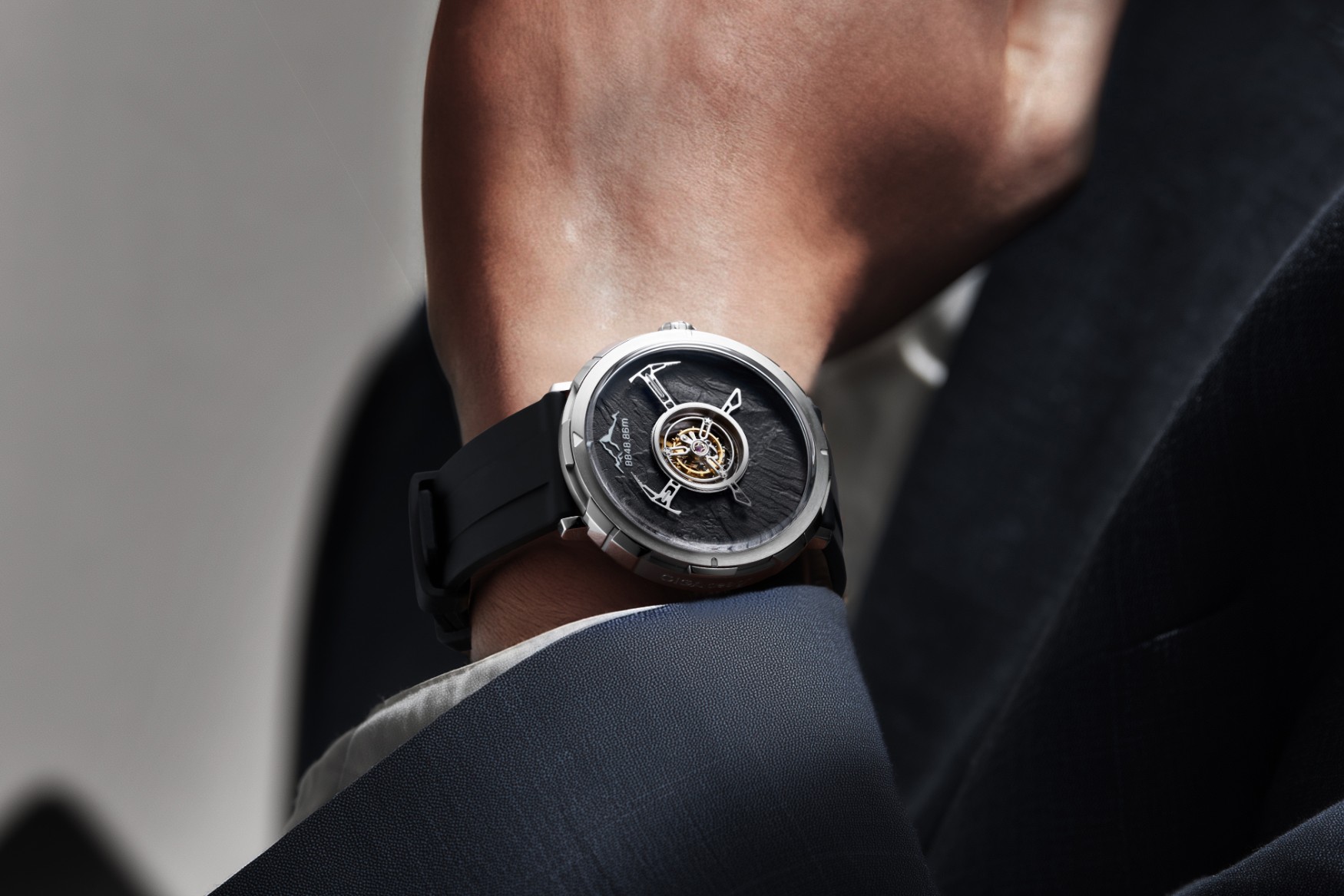
At the centre of the project (literally) is a manual‑winding central tourbillon movement, dubbed the CD‑05. Protecting it is a case that measures 45mm in diameter and 11.65mm thick: dimensions that read large on paper but are moderated by short, almost integrated lugs. The materials choice keeps mass down while the profile—flat planes, a brushed bezel with small quadrant notches, and a broad caseback ring—pushes the aesthetic toward purposeful rather than ornamental. The left flank carries a simple “CIGA design” engraving, with “CIGA” in bold, an assertive but not shouty signature in keeping with the brand’s usual understatement.
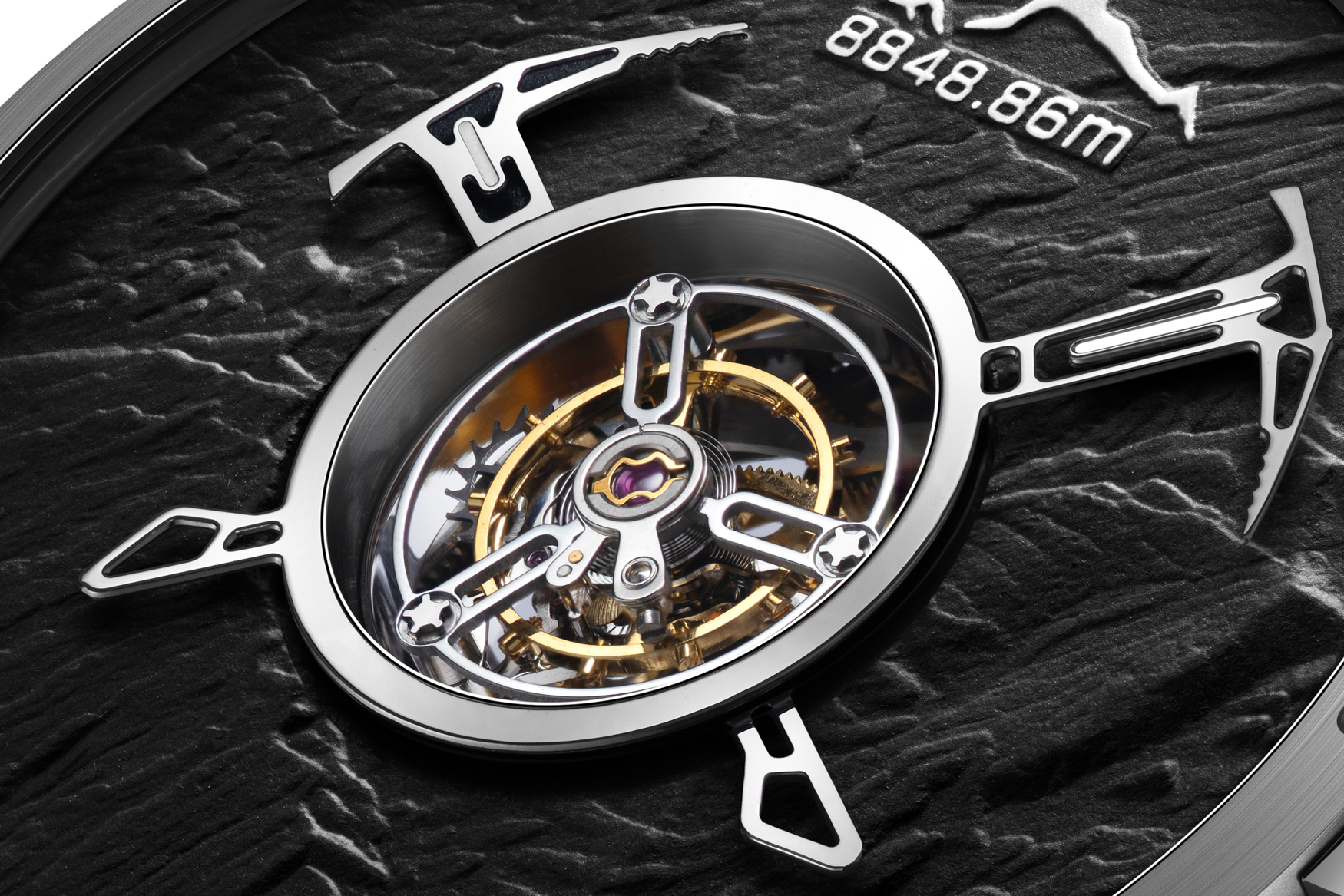
The dial is the visual and conceptual anchor. It’s made from fragments described as Everest bedrock collected at the mountain’s foothills by chief designer Jiang Xin, then subjected to a 30‑day process of precision cutting, CNC engraving and laser shaping to preserve its natural texture. That’s a pretty unique take on a stone dial! Whether one prioritises the geology or the symbolism, the result is an irregular, tactile surface that reads as neither imitation nor veneer. The narrative is reinforced by a sculpted relief of the mountain coated with Swiss Super‑LumiNova C1—an element that glows in low light without overwhelming the rest of the composition.
Right beneath the sculpted relief sits “8848.86m,” the current official altitude of the famous peak, also coated with Super-LumiNova, rendered as a crisp emblem rather than a slogan. The decision to omit a conventional minute track shifts the emphasis away from precision reading at a glance and toward an uncluttered, sculptural presentation; legibility rests on the contrast between the hands, the circular central framework and the dark stone.
Those hands are skeletonised and shaped like ice axes, directly referencing the tool associated with Sir Edmund Hillary and preserved at the Auckland Museum. It’s an overt nod, but it works because the geometry is functional: broad enough to carry luminous paint, narrow enough to avoid obscuring the tourbillon, and distinctive in silhouette. The hands pivot over a circular ring at the dial’s centre, under which the tourbillon is framed by a bridge with three radial arms. Central tourbillons remain uncommon because they complicate the already complex problem of a rotating regulator; placing that mechanism on the hand axis demands careful packaging and torque management. Here, it provides a kinetic focal point without the usual dominance of a large aperture at six.
CIGA design gives equal weight to narrative on the reverse. Engraved around the display back is Hillary’s reflection, “It’s not the mountain we conquer, but ourselves,” a sentiment that has survived countless outdoor‑gear paraphrases. Here, it frames the watch’s technical data—water resistance, power reserve, jewels—etched into the surrounding metal.

Speaking of the power reserve, it’s quite impressive, capable of powering the tourbillon for up to 120 hours using four mainsprings. A claim of a 120‑day development and refinement period suggests an iterative process focused on reliability and integration rather than inventing a complication from scratch. It’s worth noting that few watches at this price point attempt a central tourbillon at all; the decision to do so is as much about brand identity as it is about spec sheets. CIGA design is not attempting to go toe‑to‑toe with haute horlogerie on finishing; instead, it presents an unusual architecture paired with a strong materials story.
Closing thoughts

The dial execution invites macro scrutiny. The stone’s granular texture varies under different angles of light, and the luminous mountain relief has enough height to cast subtle shadows by day and to stand apart by night. Without a minute track, the watch prioritises an uncluttered look; some will miss the precision of a clear scale, others will enjoy the clean field around the central mechanics. The ice‑axe hands carry sufficient lume to make night reading straightforward, though exact minutes will still rely on eye‑balancing where the tips fall against the stone’s features. It’s the kind of compromise that makes sense if you accept the watch on its own terms: more mechanical sculpture than tool, still practical enough for daily use.
As an object, the watch is a meeting of material narrative and mechanical staging. CIGA design has taken the story of Everest—achievement, risk, persistence—and expressed it in stone, light and motion. The quote on the back is a reminder of the brand’s chosen frame: not conquest, but self‑overcoming. For CIGA design, whose reputation was made on conceptual displays like the Blue Planet, that attitude feels consistent. The Everest Summit Central Tourbillon isn’t a claim to have “arrived” in haute horlogerie; it is a step toward a more technical identity, executed with clarity about what the brand wants to be.
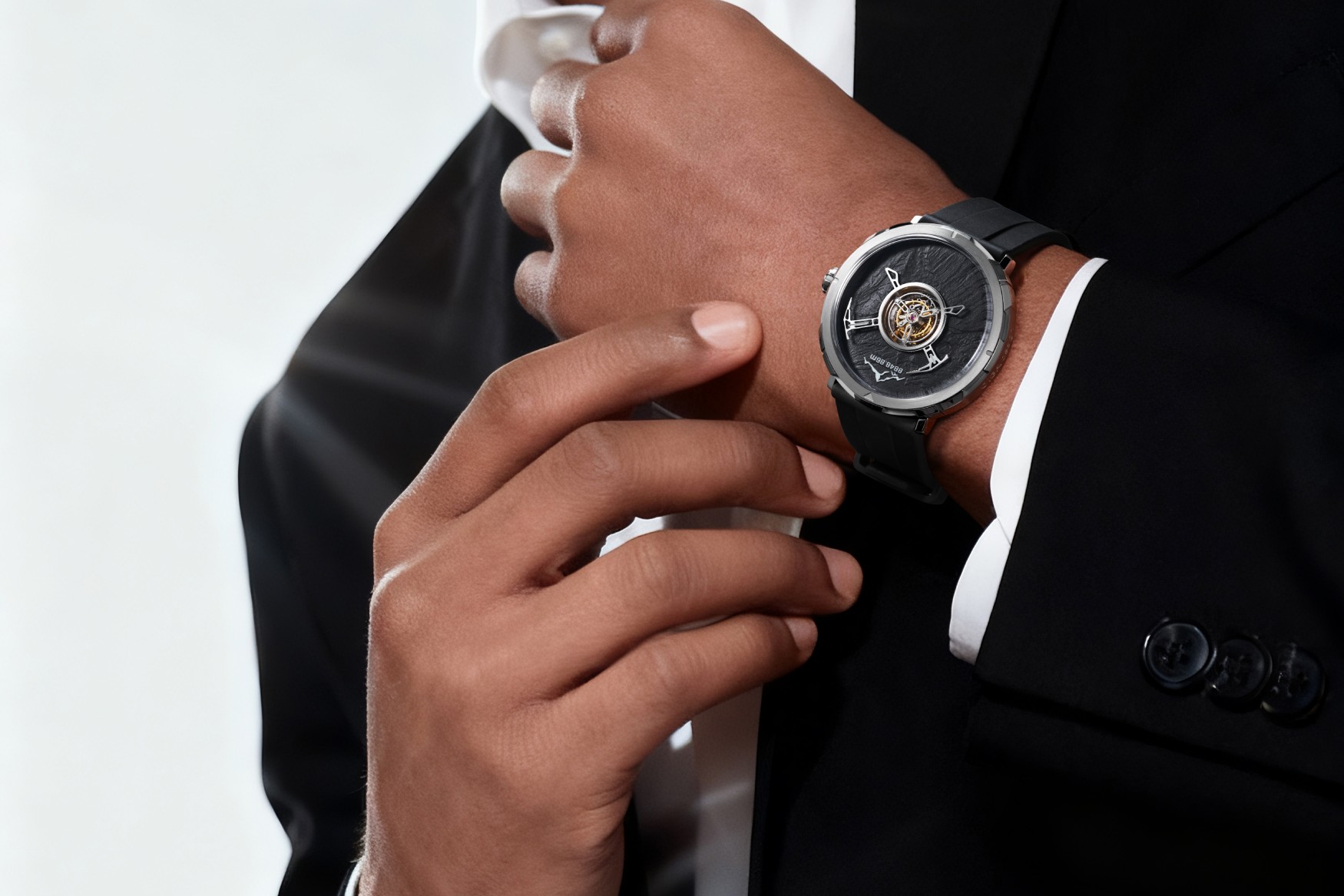
If the brief was to turn a famous mountain into a watch without resorting to clichés, this piece comes closer than most. It is thoughtful where it could have been loud, modern where it could have chased nostalgia, and confident enough to let a central tourbillon do what it does best: make time visible, right at the heart of the dial. CIGA design also gets points for meaningfully refining this watch’s design while at the same time reducing its retail price when you’d usually expect a price premium for the privilege.
CIGA design Everest Summit Central Tourbillon pricing and availability
The CIGA design Everest Summit Central Tourbillon is available now from the brand’s online boutique. Price: US$2,699
| Brand | CIGA design |
| Model | Everest Summit Central Tourbillon |
| Case Dimensions | 45mm (D) x 11.65mm (T) |
| Case Material | Grade 5 titanium |
| Water Resistance | 50 metres |
| Crystal(s) | Sapphire front and back |
| Dial | Everest bedrock |
| Strap | Black fluororrubber with butterfly clasp |
| Movement | Calibre CD-05, CIGA design-developed, manual-winding |
| Power Reserve | 120 hours |
| Functions | Hours, minutes, central tourbillon |
| Availability | Available now |
| Price | US$2,699 |