


Audemars Piguet marks 150 years with 38 mm QPs and stone‑dial tourbillons
Jason Lee- Audemars Piguet unveils a new perpetual calendar movement, Cal. 7136, and stone dial tourbillons.
- The new QP movement alongside the 2025-launched Cal. 7138, does away with the usual pin‑pushers, allowing all adjustments to be made through the crown in a system with four positions.
- The trio of stone dial tourbillon models each feature ruby root, sodalite and malachite.
Audemars Piguet has spent 150 years in Le Brassus, and its anniversary message this September is consistent: take complications the brand knows intimately and make them easier to wear. The headlines arrive in two parallel drops. First, the perpetual calendar moves to 38 mm for the first time, split across a Code 11.59 and two Royal Oaks and powered by the newly introduced Calibre 7136 alongside the 2025‑launched Calibre 7138. Second, the Code 11.59 Selfwinding Flying Tourbillon returns in 38 mm with a limited‑edition trio of natural‑stone dials — ruby root, sodalite and malachite — each matched to a white‑, pink‑ or yellow‑gold case.

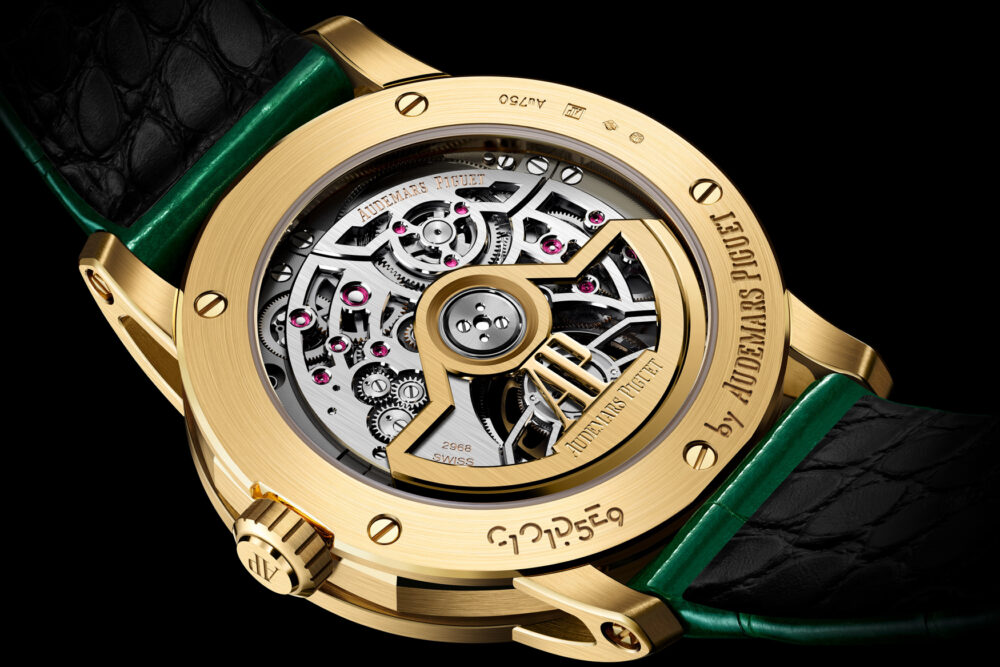
The perpetual calendar is where the practical rethink is most explicit. AP’s 38 mm format arrives with movements that are both thin and thoroughly updated: Calibre 7138, seen earlier this year in 41mm QP models, keeps a week display, while the brand‑new Calibre 7136 omits it. Both are self‑winding, 4.1 mm tall and covered by five patents. The aim is not just packaging a poetic complication in a smaller diameter but refining the day‑to‑day experience of setting, reading and wearing it. Finishing remains orthodox AP — Côtes de Genève, snailing and hand‑chamfers — visible under sapphire, and the 22‑carat pink‑gold rotor and barrel bridge occupy a prominent arc on the back.
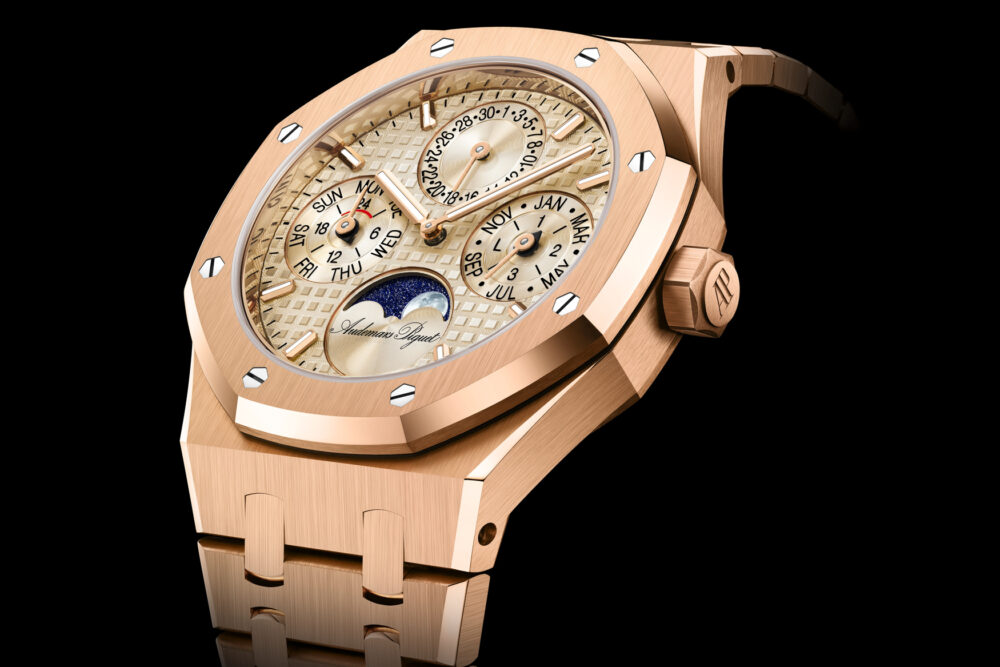
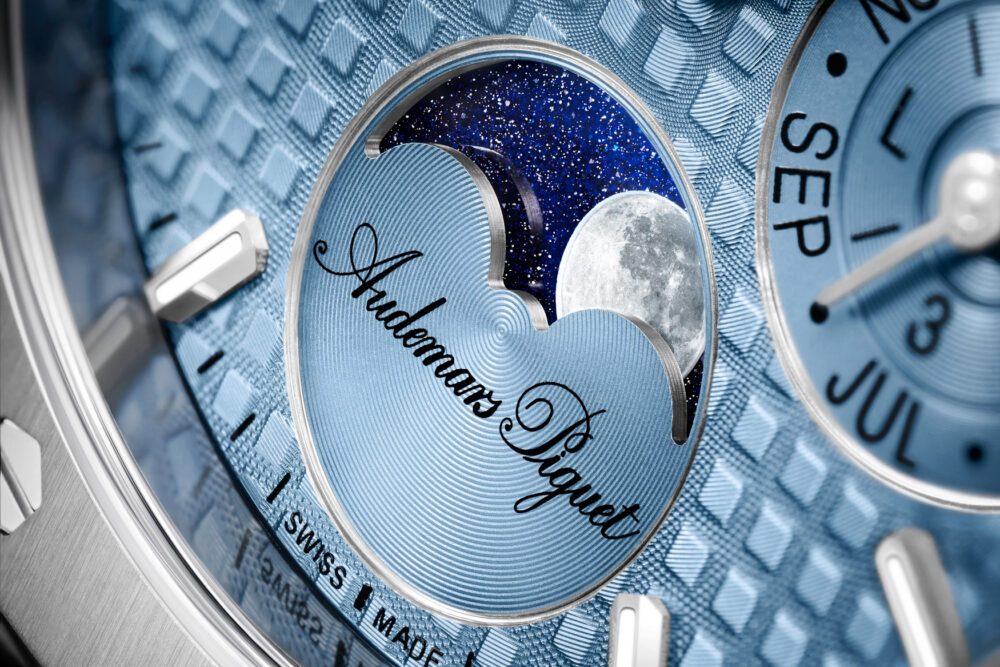
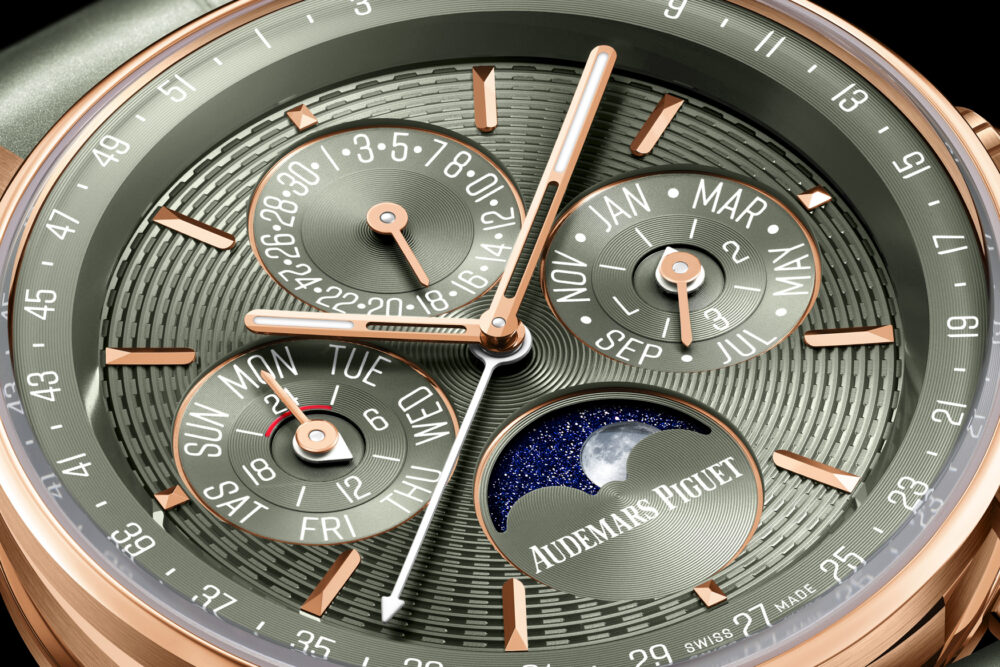
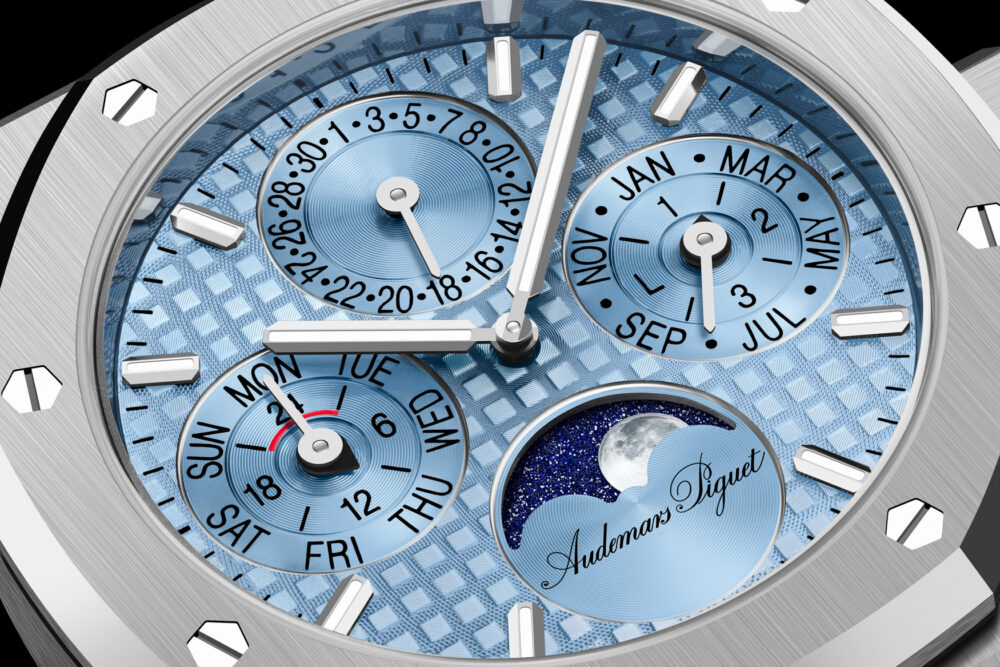
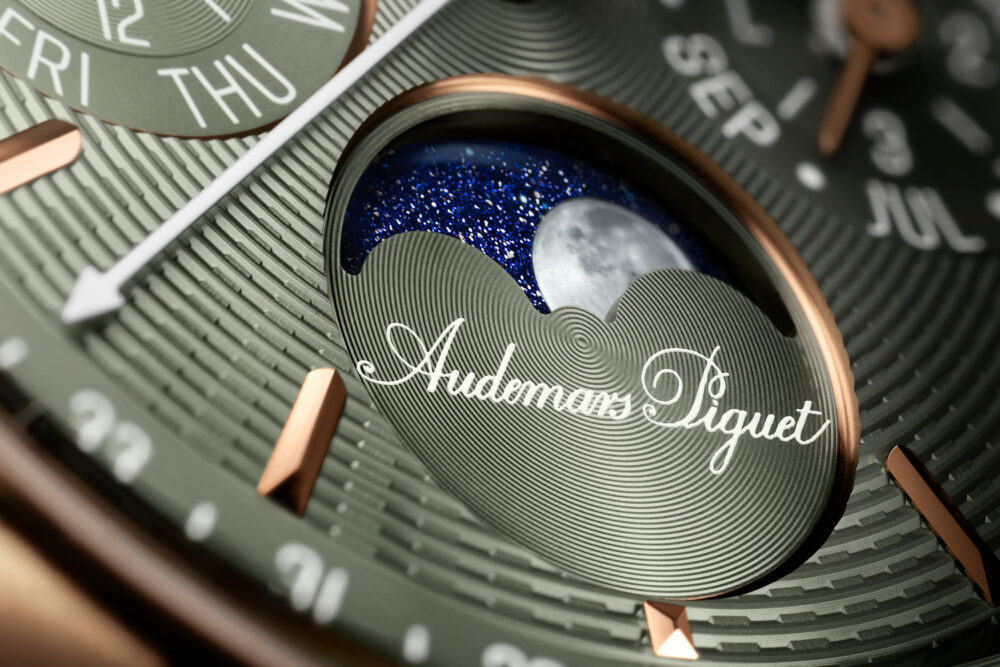
The dials have been reorganised for legibility and rhythm. Rather than the busier layouts of older references, the display reads cleanly in a European order: day at nine, date at twelve and month with leap‑year at three, while the moon‑phase remains at six but is now visually centred on the 12 o’clock axis. The date register uses a patented progressive 31‑tooth wheel so numerals appear evenly spaced around the sub‑dial, a small change that reduces the cramped feel perpetuals can suffer. On the Code 11.59 reference, the first week of the year “1” now sits at twelve; AP also aligns “MON” and “1” at twelve in their respective counters for the start of the week and month, a tidy touch you notice immediately when scanning the dial. The moon disc itself takes a realistic image from NASA.
More consequential than the dial work is the removal of case‑side correctors. In place of the usual pin‑pushers, all adjustments run through the crown in a system with four positions. A sliding‑pinion mechanism handles the handshake between the crown and the calendar work. AP prints a red non‑correction window on the 24‑hour scale from 9 pm to 3 am to mark the active changeover period; should someone adjust the watch during that window, the architecture is designed to prevent damage — a practical concession for a complication that is often left untouched for fear of mis‑setting it.
Each model keeps faith with its collection’s aesthetic brief. The Code 11.59 perpetual calendar pairs pink gold with an embossed green dial whose pattern — developed with guilloché specialist Yann Von Kaenel — uses concentric circles punctuated by minute holes to catch the light without the repetition of a stamped cloud. The week scale printed on the inner bezel helps declutter the dial properly, which feels consistent with the ergonomic narrative behind the movement.
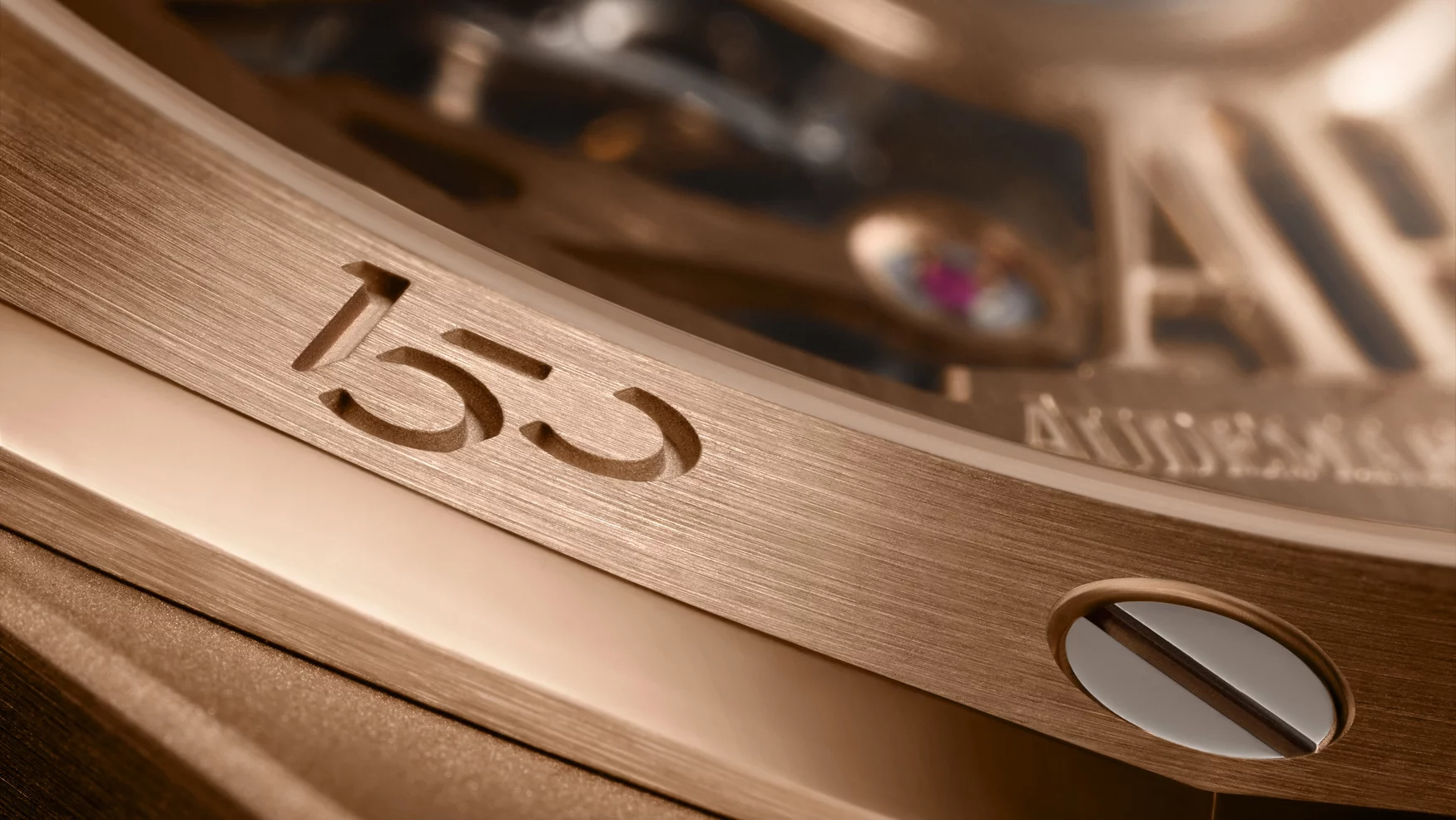
The Royal Oak pair leans into familiar signatures. In steel, the light‑blue “Grande Tapisserie” dial and matching snailed registers give a cool, technical atmosphere that suits the bracelet’s hard edges and the alternating brushed and polished facets. In pink gold, the beige dial warms the composition and sets off the blue moon‑phase disc at six; again, the snailed counters and luminous hands retain the legibility push that underpins this generation of calendars. Both watches share the same 38 mm footprint and integrate the new movement without changing the silhouette collectors know. For the anniversary year, AP also offers commemorative versions with a vintage “Audemars Piguet” signature added to the moon‑phase and 1 of 150-pieces caseback engravings, which gives a neat way for the brand to mark the date without creating wholly separate designs.
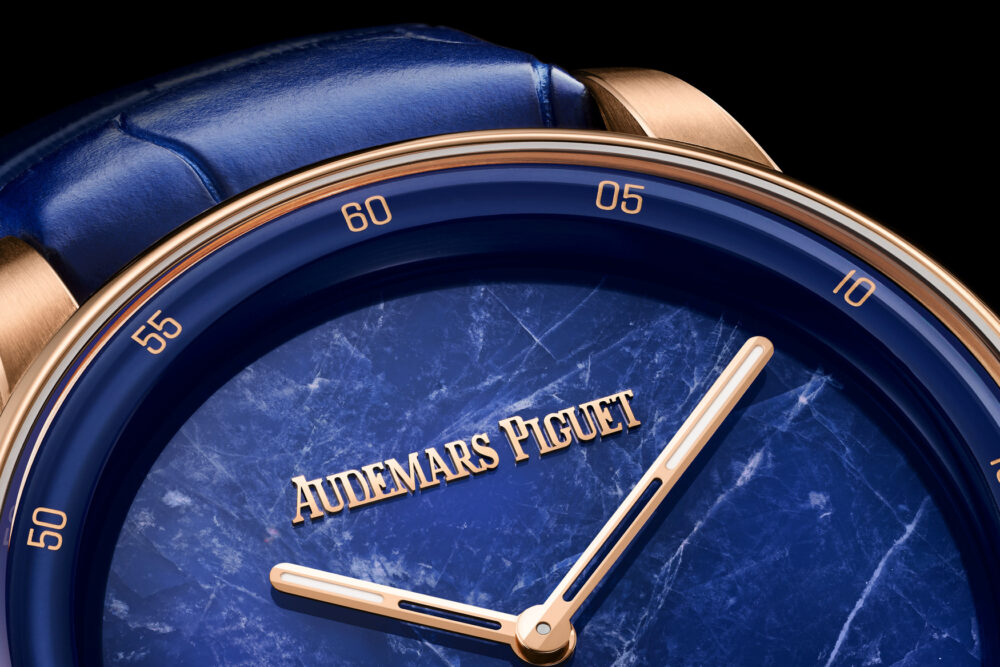
If the calendars concentrate on use, the second September drop plays with surface and colour. The Code 11.59 Selfwinding Flying Tourbillon returns in 38 mm with three natural‑stone dials — ruby root, sodalite and malachite — each matched to a precious‑metal case that amplifies the stone’s tone: white gold with the red of ruby root, pink gold with the deep blue of sodalite, yellow gold with the saturated green of malachite. The idea picks up a thread AP began tugging in the 1960s, when it experimented with hard‑stone dials across jewellery‑leaning pieces. Here, the execution aims for restraint. The flying tourbillon sits at six with a metal frame in the same alloy as the case and the inner bezel is brass with opaline decoration, colour‑matched.
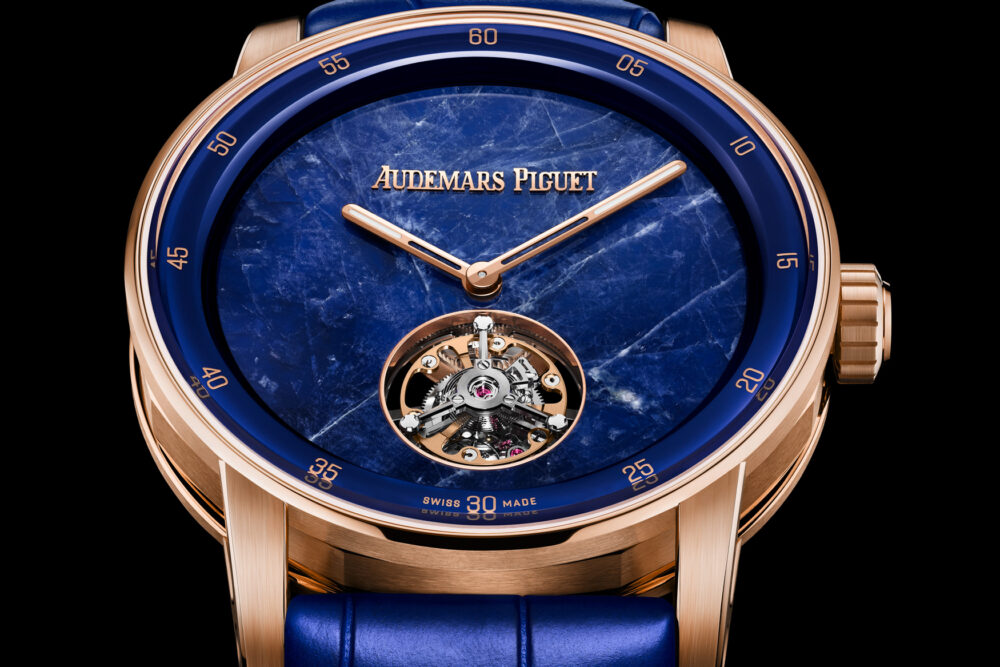
Proportions matter to the way these watches read. The 38 mm case wears slim thanks to a 9.6 mm thickness and a double‑curved sapphire that softens reflections and emphasises the Code 11.59 geometry. The dial‑matched alligator straps keep the colour story intact, with an interchangeable rubber‑coated strap available on demand. Luminous material on the hands and markers, and the standard 30 m water‑resistance, signal that despite the showpiece dials the watches are intended for regular wear rather than occasional use.
The movement, Calibre 2968, does much of the heavy lifting to make a 38 mm tourbillon feel plausible rather than gimmick‑sized. It’s an ultra‑thin self‑winding flying tourbillon conceived specifically for sub‑41 mm cases, and first appeared in the Royal Oak RD#3 in 2022. At 3.4 mm thick, it uses a peripheral drive for its titanium tourbillon cage to save mass, and a high‑amplitude escapement to stabilise energy distribution and accuracy. The “flying” architecture leaves the cage supported only from below, which clears the view at six and helps the stone dials act as a backdrop rather than a distraction.
Each stone dial is cut from a wafer‑thin slice, polished to reveal veining and tonal shifts and, crucially, thin enough not to fight case height. The brand leans into the fact that no two dials are identical. It also names sourcing: ruby root from Tanzania, sodalite from Brazil and malachite from Zambia. The brand layers in the traditional symbolic associations: vitality and protection for ruby root, calm and clarity for sodalite, growth and transformation for malachite.
Across both releases, the through‑line is miniaturisation with a purpose. AP has been public about re‑engineering complications to live at smaller sizes without giving up performance or craft. The tourbillon side of the story mirrors that logic with a calibre conceived to sit comfortably under 41 mm and a case that keeps thickness in check, while the crown‑only correction system that arrives with these 38 mm QPs further demonstrates the logic.
There are also subtle signals of how AP wants these pieces to be worn. The calendars bring a complication often seen as precious or delicate into a form factor more aligned with everyday use, and the crown‑only interface reduces the friction of ownership; for many enthusiasts, the fear of a mis‑set perpetual is a real barrier. The stone‑dial tourbillons, conversely, let materials carry some of the show while the movement stays unobtrusive, which makes them read less like exhibition pieces and more like watches that could plausibly be chosen on a morning for their colour and feel. In both cases, the brand resists the temptation to celebrate an anniversary with pure spectacle, instead opting for a quieter statement that the house’s complications can be both serious and civilised in size.
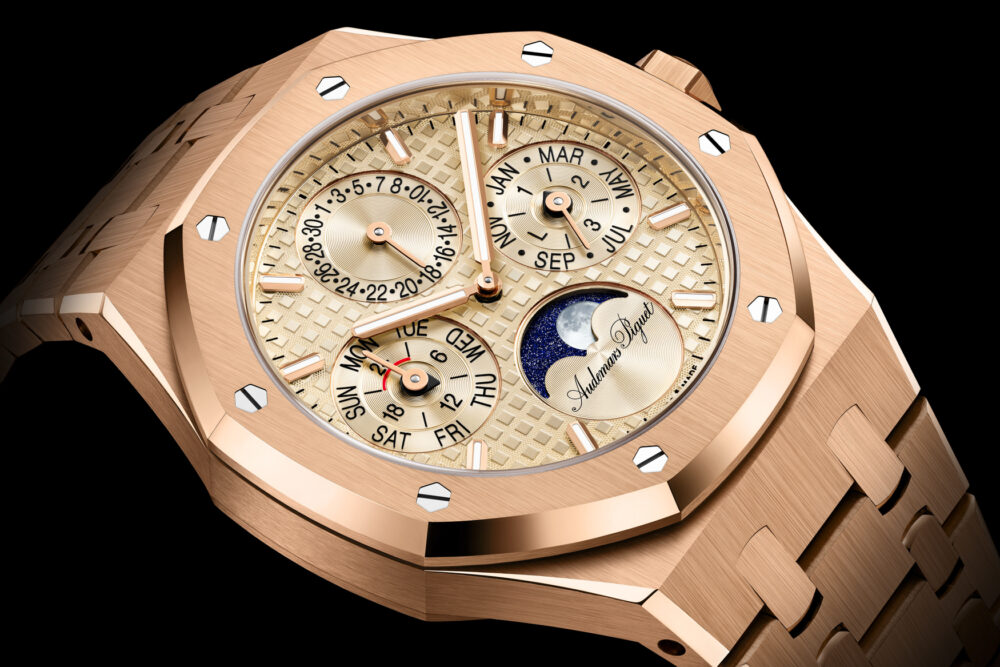
Audemars Piguet 38mm Perpetual Calendar and stone dial Tourbillon models pricing and availability
The Audemars Piguet 38mm Perpetual Calendar and stone dial Tourbillon models will be available this September and limited to 150 pieces each.
Price: CHF 82,500 (Code 11.59 Perpetual Calendar), CHF 86,500 (Royal Oak Perpetual Calendar in steel), CHF 122,500 (Royal Oak Perpetual Calendar in 18k pink gold), CHF 140,000 (Code 11.59 Flying Tourbillon)
| Brand | Audemars Piguet |
| Model | Code 11.59 Perpetual Calendar |
| Case Dimensions | 38mm (D) x 9.9mm (T) |
| Case Material | 18k pink gold |
| Water Resistance | 100m |
| Crystal(s) | Sapphire front and back |
| Dial | Green embossed |
| Lug Width | Not stated |
| Strap | Green textured rubber lined with calfskin |
| Movement | Calibre 7138 |
| Power Reserve | 55 hours |
| Functions | Hours, minutes, and perpetual calendar with leap year indicator |
| Availability | September 2025, limited to 150 |
| Price | CHF 82,500 |
| Brand | Audemars Piguet |
| Model | Royal Oak Perpetual Calendar |
| Case Dimensions | 38mm |
| Case Material | Stainless steel; 18k pink gold |
| Water Resistance | 50m |
| Crystal(s) | Sapphire front and back |
| Dial | Light blue “Grand Tapisserie”; beige “Grand Tapisserie” |
| Lug Width | Not stated |
| Strap | Integrated bracelet in steel or 18k pink gold |
| Movement | Calibre 7136 |
| Power Reserve | 55 hours |
| Functions | hours, minutes, and perpetual calendar with leap year indicator |
| Availability | September 2025, limited to 150 |
| Price | CHF 86,500 for steel
CHF 122,500 for 18k pink gold |
| Brand | Audemars Piguet |
| Model | Code 11.59 Flying Tourbillon |
| Case Dimensions | 38mm (D) x 9.6mm (T) |
| Case Material | 18k pink gold; 18k white gold; 18k yellow gold |
| Water Resistance | 30m |
| Crystal(s) | Sapphire front and back |
| Dial | Sodalite, Ruby root, or malachite |
| Lug Width | Not stated |
| Strap | Blue, red or green alligator |
| Movement |
Calibre 2968
|
| Power Reserve | 50 hours |
| Functions | Hours, minutes, and flying tourbillon |
| Availability | September 2025, limited to 150 |
| Price | CHF 140,000 |