


Jaeger‑LeCoultre brings Xu Beihong’s horses to the Reverso in enamel
Jason Lee- Jaeger-LeCoultre unveils a trio of white‑gold Reverso Tribute Enamel models pairing translucent enamel dials over hand‑guilloché with casebacks bearing miniature grand feu enamel reproductions of Xu Beihong’s horse paintings.
- The three pieces are differentiated by both the front dial treatment and the subject on the reverse.
- Limited to 10 pieces per reference, the series aligns Reverso’s equestrian origin with Chinese equestrian symbolism ahead of the Lunar New Year of the Horse in February 2026.
Jaeger‑LeCoultre has long worn the “Watchmaker of Watchmakers” sobriquet with some justification. Established in 1833 in the Vallée de Joux, the manufacture consolidated a broad array of métiers under one roof and—by its own count—has created more than 1,400 calibres and secured over 430 patents. That integrated model continues to inform how the brand builds and decorates its watches today, and it provides the context for the Reverso’s enduring relevance nearly a century after its debut.
The Reverso began life in 1931 with a practical brief: protect a watch dial during polo. The solution—a rectangular case that slides and flips to reveal a solid metal reverse—proved robust enough for the sport while establishing a particularly pure Art Deco profile. Over nine decades, the line has remained recognisable even as it diversified technically and aesthetically; Jaeger-LeCoultre notes that its blank verso has become a natural stage for decorative arts, including engraving, grand feu enamel, and gem setting. In that sense, the model has always been both an instrument and a medium.
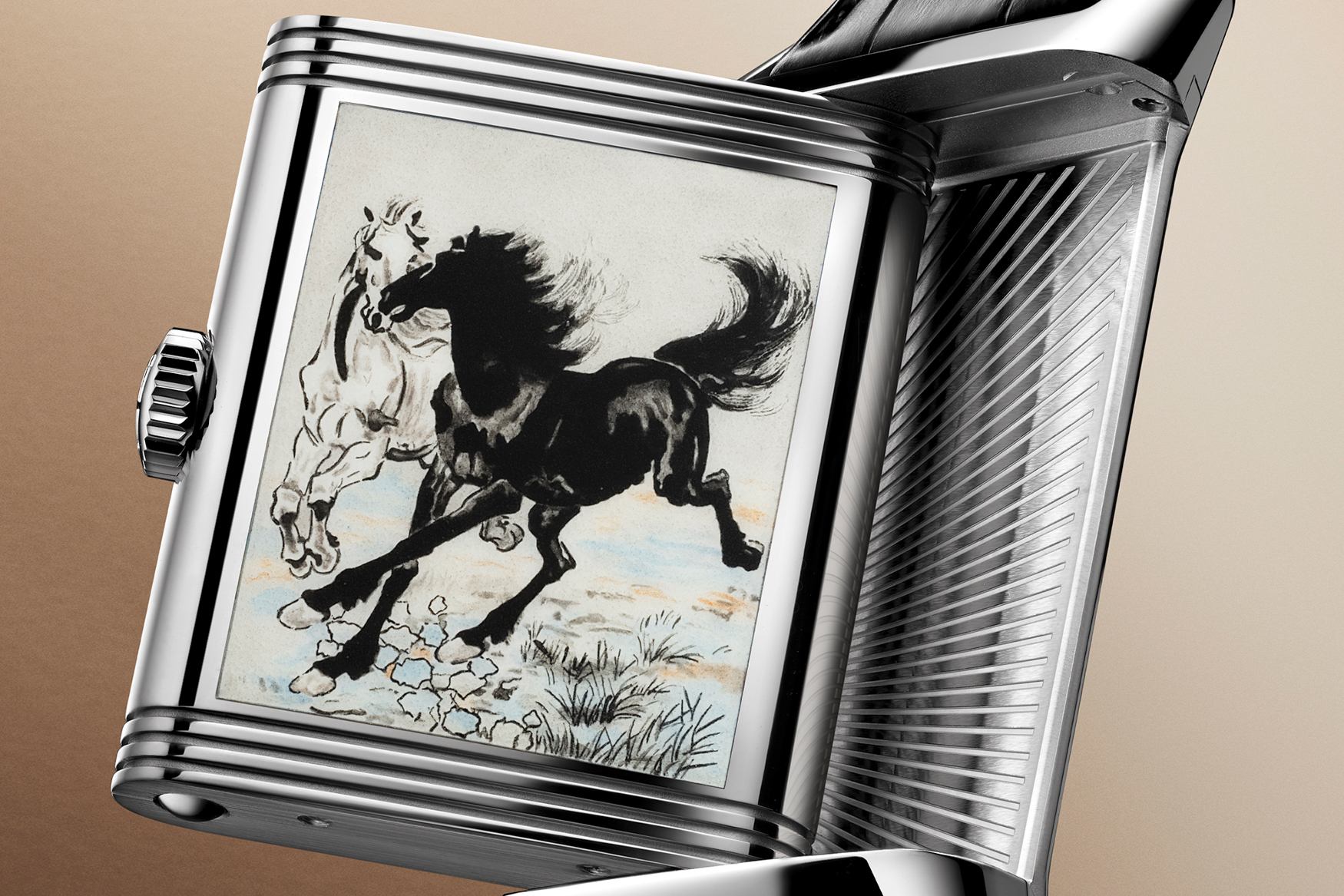
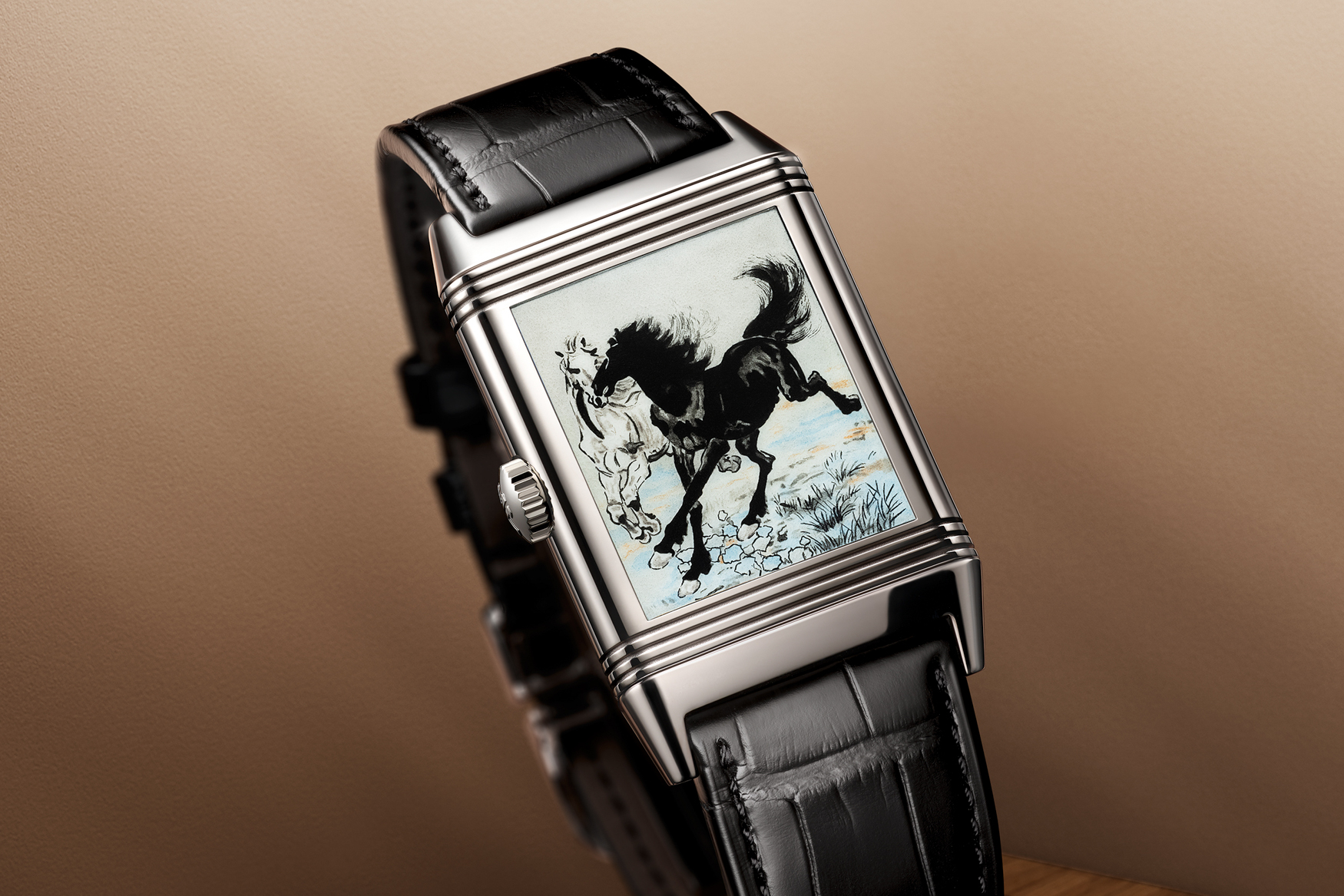
Seen against that backdrop, the new Reverso Tribute Enamel “Xu Beihong” trio fits neatly into the model’s decorative tradition. Each watch pairs a translucent grand feu enamel dial laid over hand‑executed guillochage with a caseback miniature in grand feu enamel after a work by Xu Beihong (1895–1953), the influential Chinese artist and educator known for ink‑and‑wash depictions of horses and birds. The set is being presented in advance of the Lunar New Year of the Horse in February 2026, and the connection to Reverso’s equestrian origin story is explicit. Each reference is limited to 10 pieces.
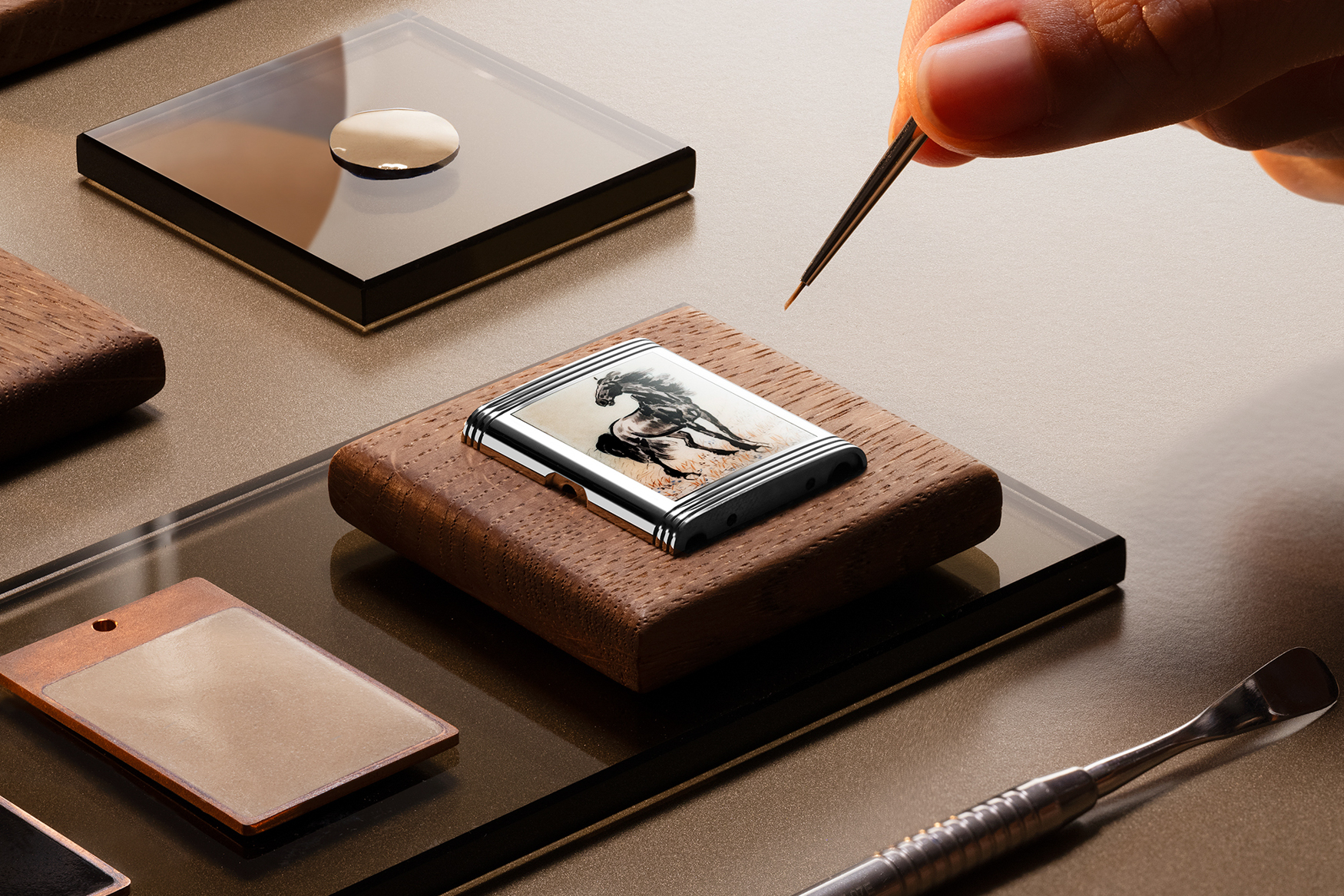
Xu’s place in 20th-century Chinese art is straightforward to state and difficult to overstate. He advocated drawing from life and sought to refresh tradition through engagement with Western training—studying at the École des Beaux‑Arts and travelling extensively in Europe between 1919 and 1927—while retaining ink‑and‑wash as a primary vehicle. In his horses, economical brushwork translates musculature, balance and forward motion with very few strokes; symbolism is present but secondary to observed form.
Compressing that language to a Reverso caseback demands technical control: the painter must translate sweeping calligraphic marks into minute gestures capable of surviving repeated firings. Jaeger‑LeCoultre describes the reduction from originals exceeding a square metre to an enamelled surface of roughly 2 cm², with about 80 hours of painting required for each caseback before firing and finishing.
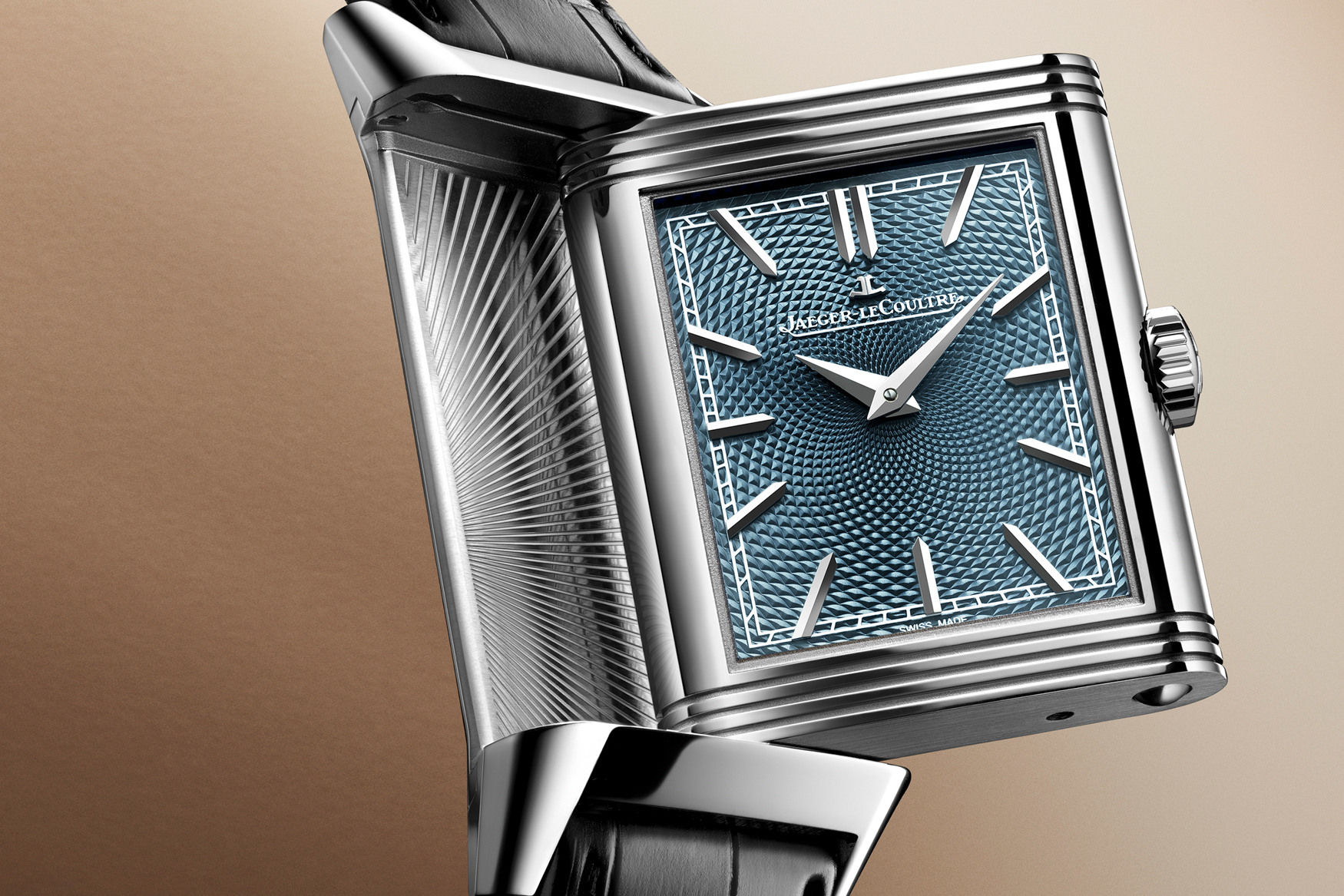
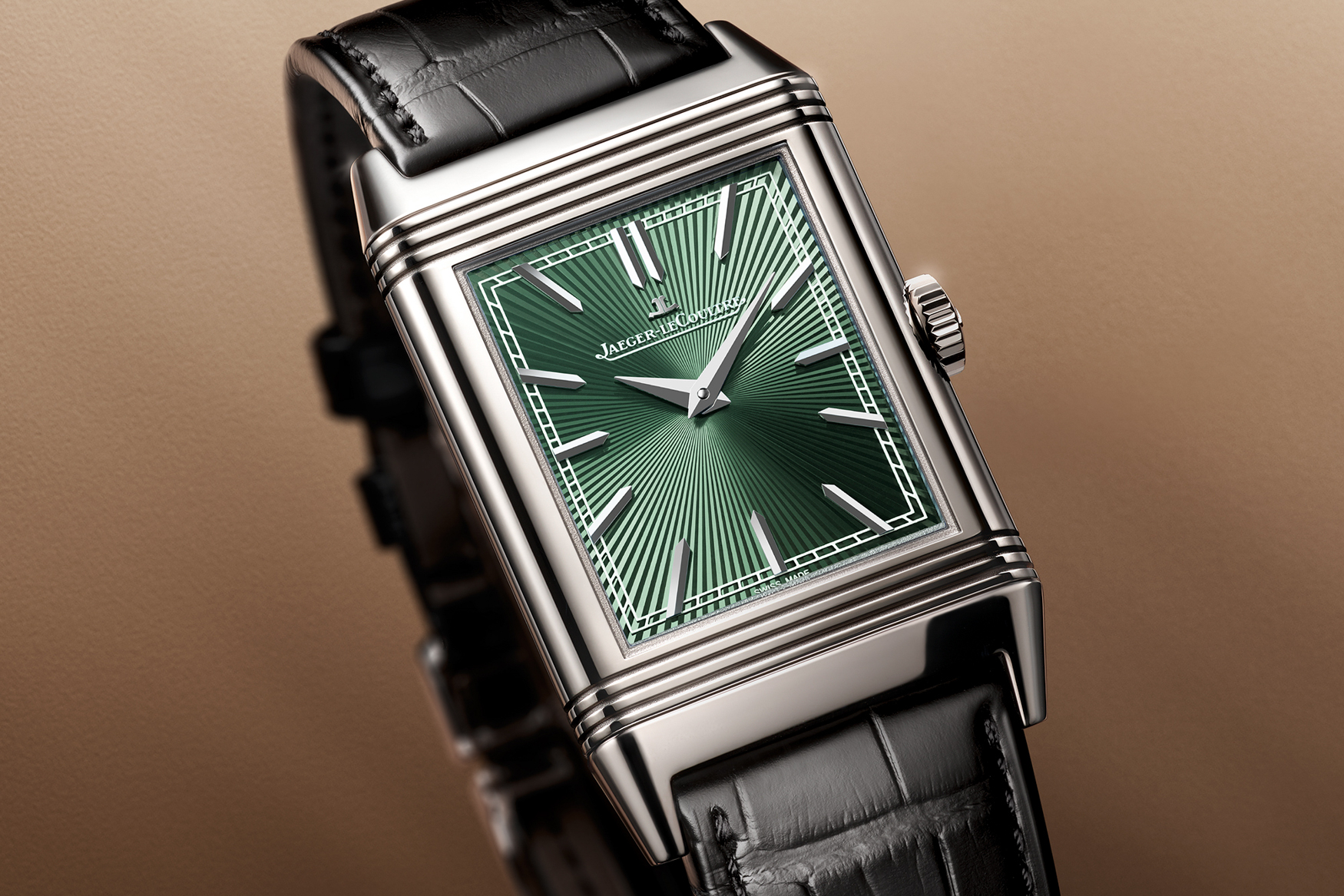
On the dial side, all three watches aim for a dialogue rather than a literal echo. Translucent enamel colours—chosen to resonate with tones common in Chinese landscape painting—sit above distinct guilloché patterns. The metalwork matters because guillochage shapes how light travels under the enamel; a sunray, barley‑seed or herringbone will each send reflections differently and, as a result, alter the perceived depth of the colour. The visual impression is restrained: no date, and a two‑hand layout that leaves the field open for tone and texture.
The three pieces are differentiated by both the front dial treatment and the subject on the reverse. “The Running Horse” presents a single galloping figure characterised by the maison as majesty and grace; its dial is Evergreen Pine Green over a sunray guilloché with 120 engraved lines. “Two Horses” depicts a black and a white horse in motion—energy and mutual affinity—and sets a Distant Mountain Blue enamel over a barley‑seed guilloché. “The Standing Horse” takes a quieter stance, after Xu’s 1939 portrait emphasising nobility and latent power; here, the dial is a soft Crimson Dawn Orange above a herringbone pattern with 120 lines. Two of the casebacks reference Xu’s 1942 Running Together (Six Horses)—itself a nod to the Tang‑dynasty Six Steeds of the Zhao Mausoleum—while the third follows Standing Horse (1939).
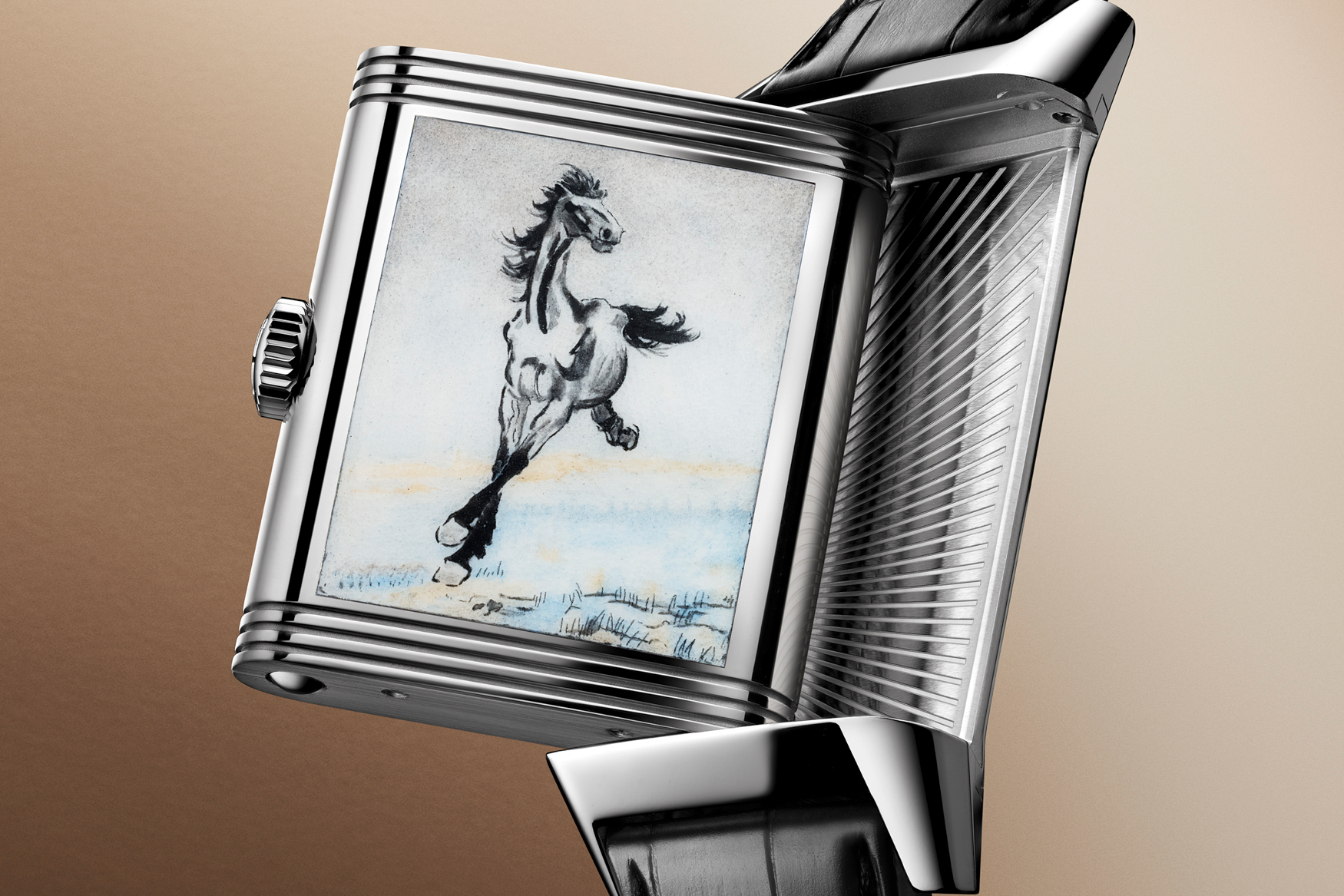
Technical commonalities are straightforward. Cases are 18k white gold in the familiar Reverso Tribute footprint, measuring 45.6 × 27.4 × 9.73 mm, with a water‑resistance rating of 30m. Inside sits the manually-wound in-house calibre 822, which offers 42 hours of power reserve and beats at 3 Hz. The watches are delivered on black alligator straps with interchangeable double‑folding clasps.
Closing thoughts
The project is notable for its alignment of idea and medium. The Reverso format allows the wearer to keep the dial forward and the artwork protected during daily wear, reserving the miniature for private viewing or conversation. It’s a functional approach to decorative work that avoids relegating art to mere dial texturing. Because the caseback paintings are reproductions rather than free interpretations, the exercise is less about collaboration with a living artist than it is about translation—moving a known image into vitreous enamel at a different scale, with different constraints.
This release reinforces the two strands that tend to define Jaeger‑LeCoultre in the minds of enthusiasts. The first is a technical strand built on deep movement capability and an integrated manufacture that has historically supported both its own collections and those of its peers. The second is a design strand embodied by the Reverso, a watch that has proven to be unusually receptive to métiers d’art without losing sight of its original purpose. The Xu Beihong trio simply follows those lines to a logical conclusion: a pair of art‑on‑the‑wrist canvases you can actually wear, and a reminder that even when the story is on the reverse, the watch still has to function first.
Jaeger-LeCoultre Reverso Tribute Enamel ‘Xu Beihong’ pricing and availability
The Jaeger-LeCoultre Reverso Tribute Enamel ‘Xu Beihong’ collection is limited to 10 pieces per reference, available directly from Jaeger-LeCoultre boutiques starting this September. Price: upon request
| Brand | Jaeger-LeCoultre |
| Model | Reverso Tribute Enamel ‘Xu Beihong’ |
| Reference | Q39334B1 Q39334B2 Q39334B3 |
| Case Dimensions | 45.6 x 27.4mm (D) x 9.73mm (T) |
| Case Material | 18K white gold |
| Water Resistance | 30 meters |
| Crystal(s) | Sapphire front and back |
| Dial | Sunray-pattern, barley-seed or herringbone guilloché and grand feu enamel |
| Strap | Blue alligator leather with interchangeable double-folding clasp |
| Movement | Calibre 822, in-house, manual-winding |
| Power Reserve | 42 hours |
| Functions | Hours and minutes |
| Availability | Limited to 10 pieces per reference |
| Price | Upon request |