


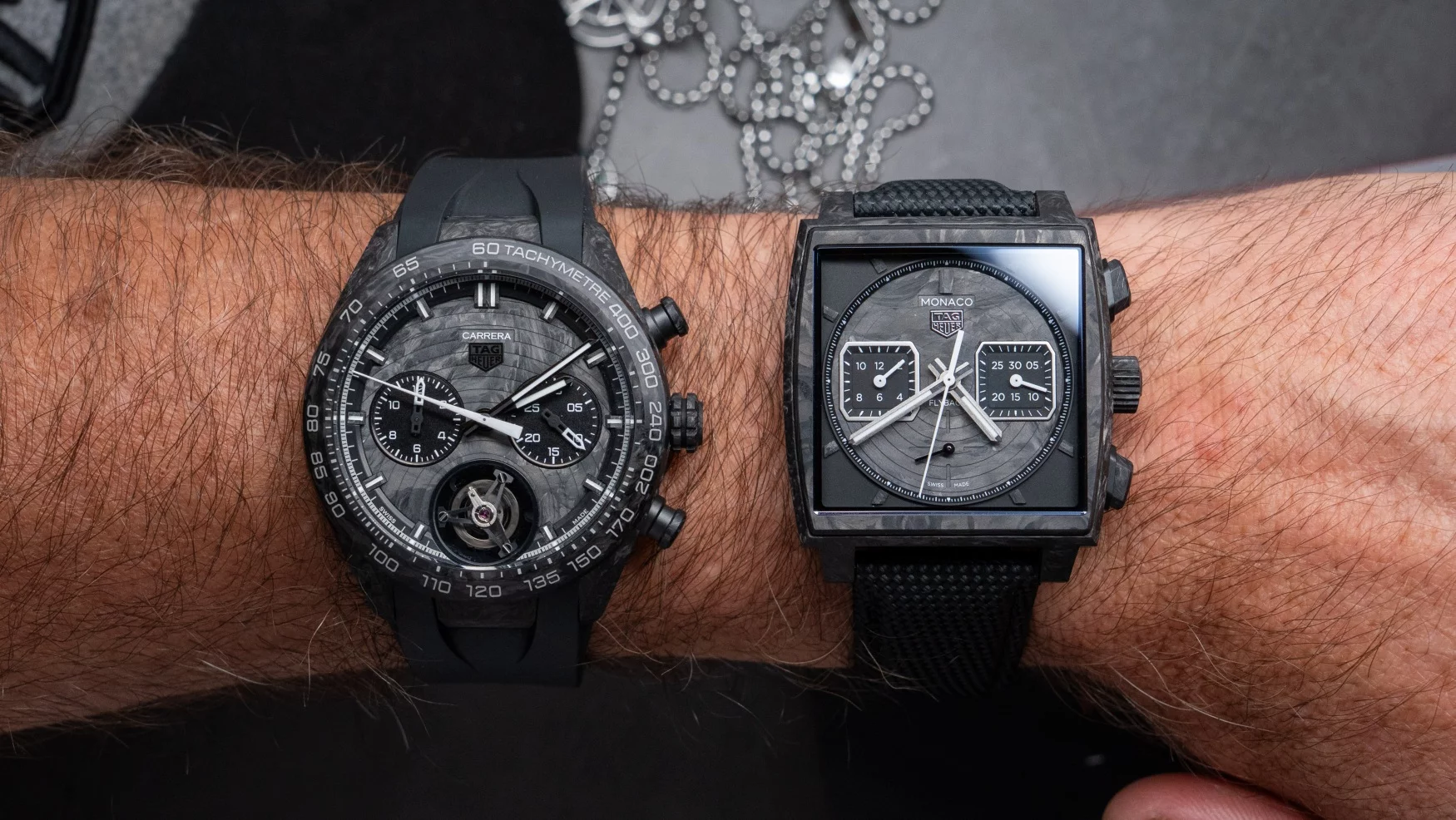
TAG Heuer debuts two chronographs with revolutionary carbon hairsprings, a technology they’ve been developing for almost a decade
Jamie WeissThe hairspring (also called a balance spring) is one of the most fragile yet most important components of a mechanical timepiece. Invented in 1675 by Dutch polymath Christian Huygens, this tiny spiral-shaped spring controls the oscillation of a watch movement’s balance wheel, and therefore regulates the speed of a watch. It is, both figuratively and literally, the heart of a mechanical watch. But as anyone who’s ever tried assembling a watch movement knows, they’re delicate things. Because they’re so thin, they’re easy to bend out of shape. More critically, however, they’re also extremely susceptible to shocks, temperature changes and magnetic fields.
For most of the history of watchmaking, hairsprings were made out of steel. In the late 20th and 21st centuries, brands have embraced silicon hairsprings, as silicon is amagnetic, highly temperature-resistant, shock-resistant and light. However, over the last decade, TAG Heuer has been quietly developing the next quantum leap in hairspring technology: carbon hairsprings. And it’s this technology that they seem to have finally perfected in 2025, unveiling two technical versions of its most iconic chronographs utilising what they’ve dubbed “TH-Carbonspring” technology in time for Geneva Watch Days 2025.
Some carbon hairspring history
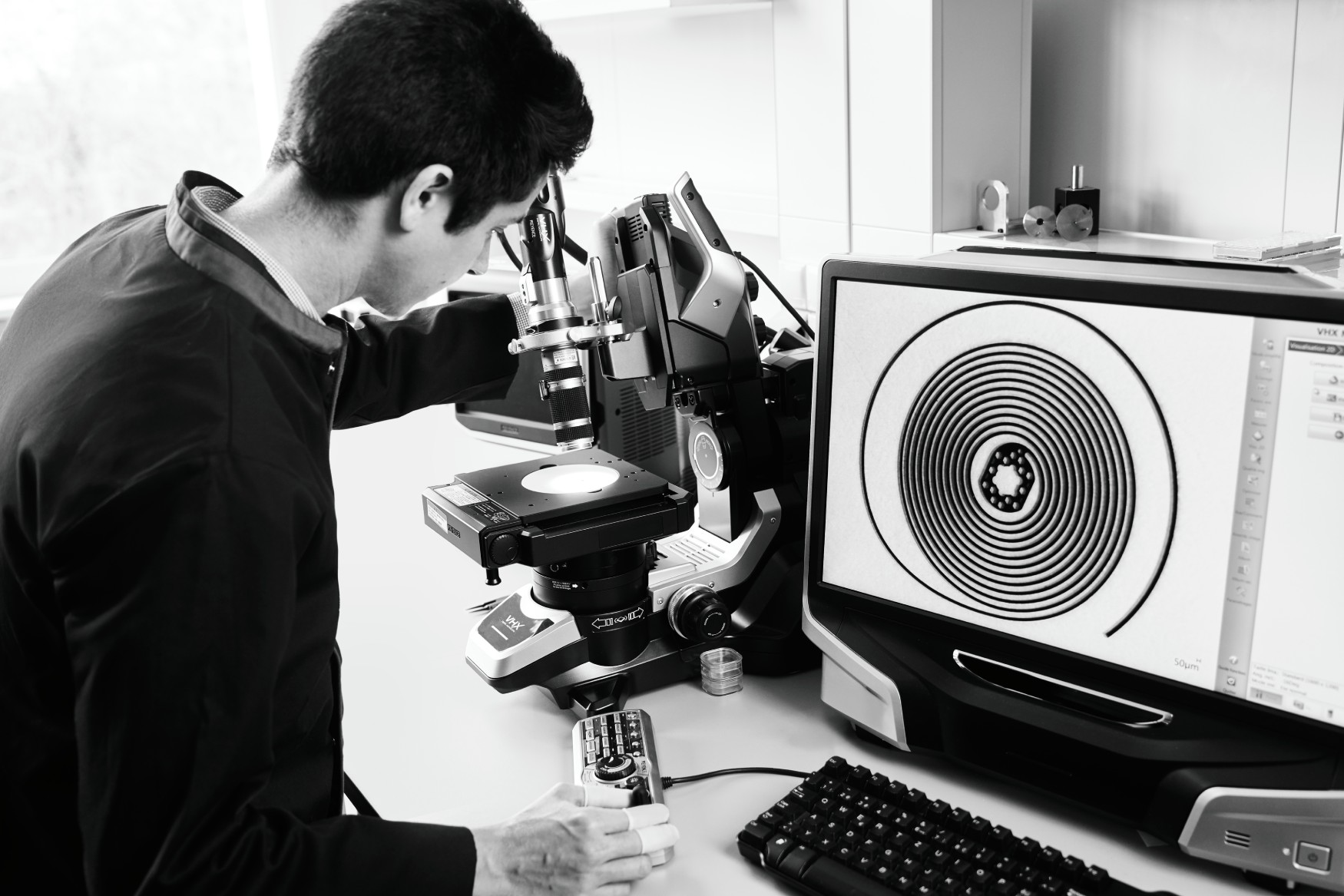
Before we dive into these two watches – the Carrera Chronograph Tourbillon Extreme Sport TH-Carbonspring and the Monaco Flyback Chronograph TH-Carbonspring – let me explain why these carbon hairsprings are so significant, and provide some background to TAG Heuer’s development of them. Firstly, the obvious one: why carbon? Well, simply put, carbon (or rather carbon nanotubes, which are the basis of the TH-Carbonspring) is even lighter than silicon, which makes it even more resistant to gravity and therefore even more accurate.
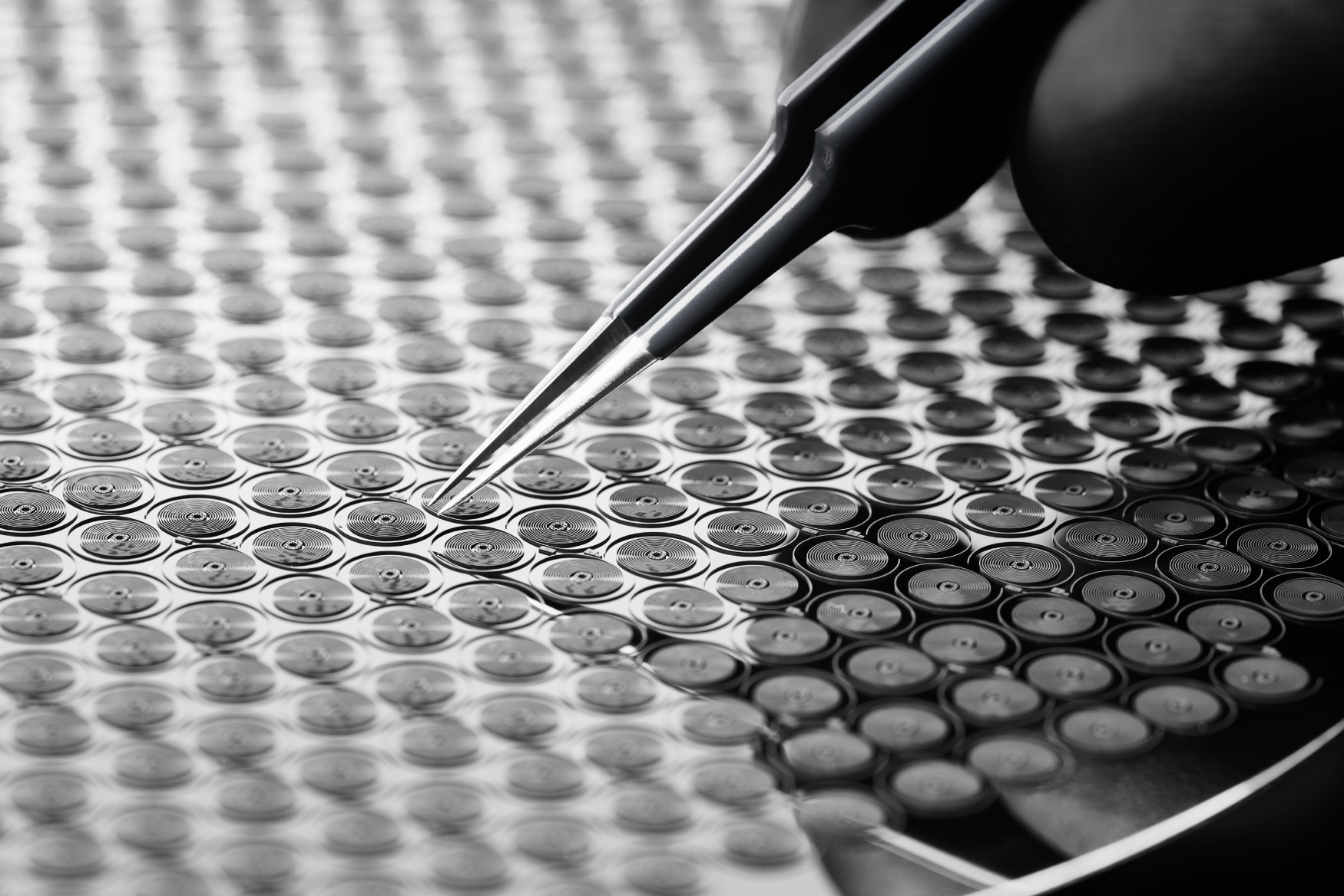
It’s also worth mentioning that the development of silicon hairsprings, from 2002 to 2022, was also covered by a patent, restricting its commercial use to a consortium of brands including Rolex, Patek Philippe, the Swatch Group and Ulysse Nardin, the latter of which pioneered the technology. This is likely what sparked TAG’s move to carbon hairsprings, but considering the patent on silicon expired three years ago, TAG is clearly confident that carbon is still relevant. To date, only Zenith and TAG Heuer have been active in the development of carbon hairsprings, with TAG really being the sole horse in this race as of publishing.

Back in 2019, TAG unveiled its first production timepieces utilising a carbon hairspring, the limited-edition Carrera Calibre Heuer 02T Tourbillon Nanograph and the Autavia Isograph collection; however, these didn’t prove to be the game-changers TAG envisioned, with the Autavia returning to standard hairsprings and the elite TAG Heuer LAB R&D department going back to the drawing board. 2021’s TAG Heuer Only Watch Carbon Monaco also used a carbon hairspring, but that was a piece unique. The Carrera Chronograph Tourbillon Extreme Sport TH-Carbonspring and Monaco Flyback Chronograph TH-Carbonspring, however, represent the maturation and commercialisation of carbon hairspring technology, which is why they’re very exciting watches.
The cases
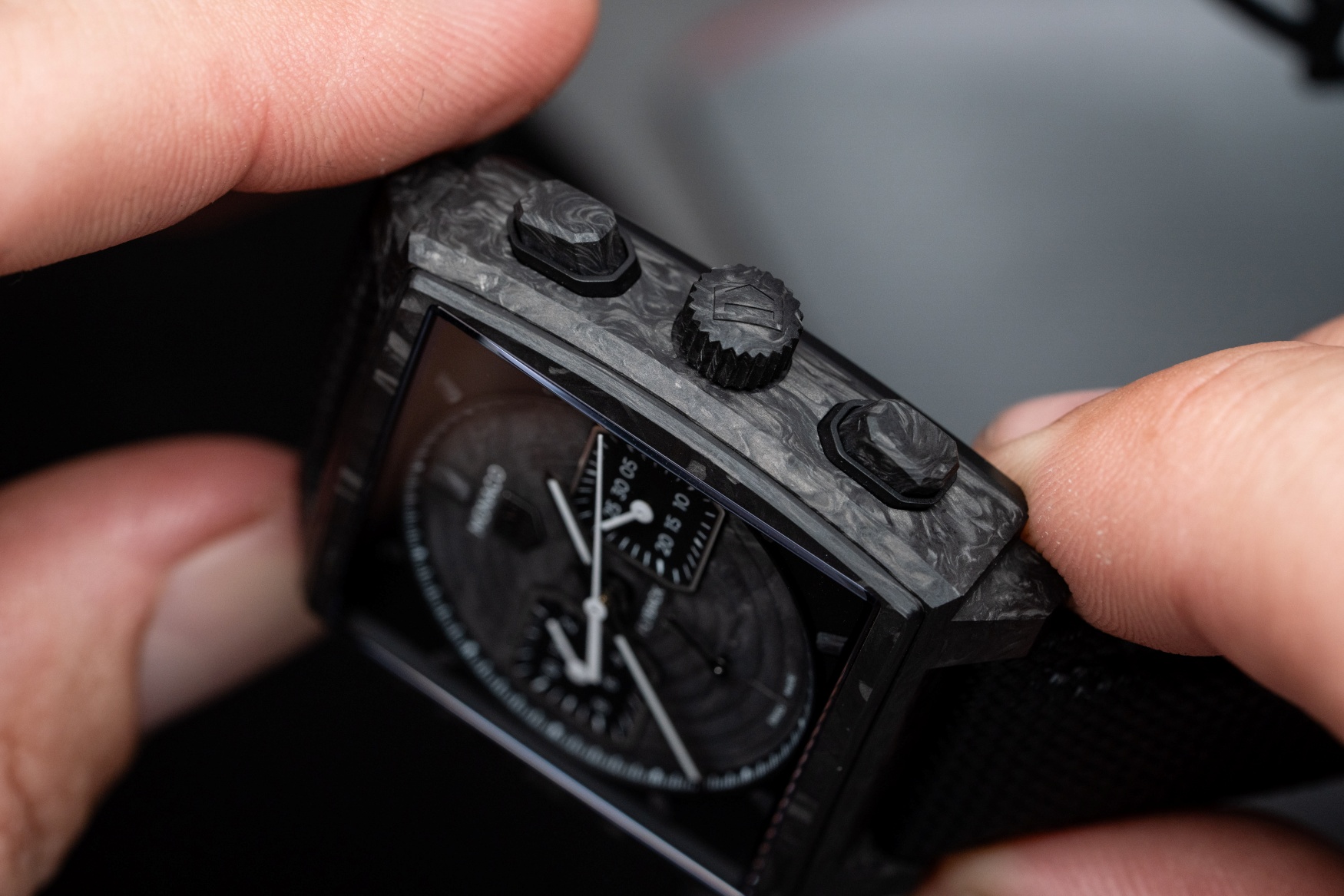
So, let’s get to the watches, shall we? It makes sense that TAG would want to showcase its coolest and most impressive movement tech inside its two most iconic chronographs, and it also makes sense that they’d put carbon hairsprings inside forged carbon fibre-cased watches. And there’s a lot of carbon on display: other than their caseback rings and strap clasps, which are made from grade 2 titanium, every part of both the Carrera Chronograph Tourbillon Extreme Sport TH-Carbonspring and the Monaco Flyback Chronograph TH-Carbonspring’s cases – bezels, crowns, chronograph pushers, end links in the Carrera’s case – are made from forged carbon fibre.

The Carrera Chronograph Tourbillon Extreme Sport TH-Carbonspring measures up a not-insubstantial 44mm in diameter, with a 49.7mm lug-to-lug and 15.4mm thickness. The Carrera Extreme Sport is intended to be a bolder, brasher take on the Carrera, and this is a complicated watch, so the large dimensions can be forgiven – although being cased in carbon, it’s not a heavyweight on the wrist. Another lightweight touch it brings to the table is some motorsports-esque filleting on its case barrel and lug sides.

The Monaco Flyback Chronograph TH-Carbonspring is a slightly more approachable 39mm in diameter, with a 47.4mm lug-to-lug and 14.1mm thickness. That said, the Monaco wears naturally on the bigger side – it is not a demure watch. The forged carbon used for both it and the Carrera has a pleasant matte finish, with the carbon’s mottled appearance giving it a proper sci-fi look.
The dials

Both of these TH-Carbonspring models have similar dials. Made from the same forged carbon fibre as their cases, they feature an almost contemplative ripple pattern which, like their hairsprings, is snail-shaped rather than perfectly concentric. It’s a nice nod to the impressive development that these watches are meant to showcase: I particularly like how the Carrera’s ripples seem to radiate out from the large tourbillon aperture at 6 o’clock, like a stone tossed into a horological pond.
The straps

The Monaco comes mounted on a black textile strap with a leatherette backing, while the Carrera sports a rubber strap with forged carbon endlinks. Both straps are secured on the wrist with familiar black DLC grade 2 titanium folding clasps sporting a TAG Heuer shield detail. They’re totally serviceable straps, although I would’ve loved if TAG had fully committed to the carbon bit and given them full carbon bracelets (the carbon endlinks for the Carrera are a nice compromise).
The movements

Now, back to the hairsprings! To showcase these TH-Carbonsprings, TAG has opted to pair the technology with two of the most complex movements they have in their arsenal: a flyback chronograph and a chronograph plus flying tourbillon. TAG could’ve just shown off the TH-Carbonspring with a simple three-hander, but I like that they’ve really gone all-out here. Both are also COSC-certified.

The movement in the Monaco is designated the Calibre TH20-60, which is an evolution of the Heuer 02 Flyback calibre, which was notably utilised in the similarly carbon-clad Monza Flyback Chronometer from 2023, but based on the brand’s current TH20-00 movement architecture. Despite the inherently power-hungry nature of a flyback chronograph complication, it features a beefy 80-hour power reserve.

Similarly, the Carrera’s calibre TH20-61 is a rework of the Heuer 02 Tourbillon movement we’ve seen in an array of Carrera Tourbillon models over the years, additionally reworked with the addition of the TH-Carbonspring, which takes pride of place as the beating heart within the flying tourbillon. It too has an impressive 65-hour power reserve.
The verdict

Modern TAG Heuer isn’t a brand many immediately associate with cutting-edge innovation in the watch industry… Which is perhaps slightly unfair, all things considered. TAG have done pioneering things with lab-grown diamonds, for example, and has added increasingly horologically mature movements to its range, such as its Vaucher-co-developed TH81-00 rattrapante calibre. Now it seems they’ve finally perfected carbon hairspring technology, which could prove to be a total game-changer not only for the brand but for the entire watch industry.

We’ll just have to wait and see. In the meantime, however, these two super-cool carbon chronos are aesthetic as well as technical knock-outs. The Carrera gets points for putting that TH-Carbonspring front and centre, but I’d personally want the Monaco in my collection.
TAG Heuer Carrera Chronograph Tourbillon Extreme Sport TH-Carbonspring and Monaco Flyback Chronograph TH-Carbonspring pricing and availability

The TAG Heuer Monaco Flyback Chronograph TH-Carbonspring and Carrera Chronograph Tourbillon Extreme Sport TH-Carbonspring are both limited editions of 50 individually numbered pieces, available from December 2025. Price: CHF 17,000, US$20,000, A$26,400 (Monaco), CHF 40,000, US$45,000, A$62,200 (Carrera Extreme Sport)
| Brand | TAG Heuer | |
| Model | Monaco Flyback Chronograph TH-Carbonspring | Carrera Chronograph Tourbillon Extreme Sport TH-Carbonspring |
| Reference Number | CBL5190.FT6313 | CBU5091.FT6305 |
| Case Dimensions | 39mm (D) x 14.1mm (T) x 47.4mm (LTL) | 44mm (D) x 15.4mm (T) x 49.7mm (LTL) |
| Case Material | Forged carbon fibre, grade 2 titanium caseback ring | Forged carbon fibre, grade 2 titanium caseback ring |
| Water Resistance | 100 metres | 100 metres |
| Crystal(s) | Sapphire front and back | Sapphire front and back |
| Dial | Forged carbon fibre dial with spiral-shaped engraving | Forged carbon fibre dial with spiral-shaped engraving |
| Strap | Black textile strap, black DLC grade 2 titanium folding clasp | Black rubber strap, forged carbon end links, black DLC grade 2 titanium folding clasp |
| Movement | Calibre TH20-60, in-house, automatic, COSC, TH-Carbonspring oscillator | Calibre TH20-61, in-house, automatic, COSC, TH-Carbonspring oscillator |
| Power Reserve | 80 hours | 65 hours |
| Functions | Hours, minutes, running seconds, flyback chronograph | Hours, minutes, running seconds, chronograph, flying tourbillon |
| Availability | Limited to 50 pieces, available from December 2025 | Limited to 50 pieces, available from December 2025 |
| Price | CHF 17,000 US$20,000 A$26,400 |
CHF 40,000 US$45,000 A$62,200 |